
Editor, Webmaster: Phil Cartwright Editor@earlyjas.org
 | |  | |  |
 | |  | |  |

|
Bessie Smith
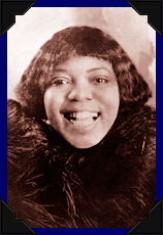
Bessie Smith was a rough, crude, violent woman. She was also
the greatest of the classic Blues singers of the 1920s. Bessie
started out as a street musician in Chattanooga. In 1912 Bessie
joined a traveling show as a dancer and singer. The show
featured Pa and Ma Rainey, and Smith developed a friendship
with Ma. Ma Rainey was Bessie's mentor and she stayed with
her show until 1915. Bessie then joined the T.O.B.A. vaudeville
circuit and gradually built up her own following in the south
and along the eastern seaboard. The proper name of T.O.B.A. is
Theater Owners Booking Association. TOBA focused on black
artists and musicians. These musicians were not treated very
well and TOBA soon became known as ‘Tough On Black Asses’.
the greatest of the classic Blues singers of the 1920s. Bessie
started out as a street musician in Chattanooga. In 1912 Bessie
joined a traveling show as a dancer and singer. The show
featured Pa and Ma Rainey, and Smith developed a friendship
with Ma. Ma Rainey was Bessie's mentor and she stayed with
her show until 1915. Bessie then joined the T.O.B.A. vaudeville
circuit and gradually built up her own following in the south
and along the eastern seaboard. The proper name of T.O.B.A. is
Theater Owners Booking Association. TOBA focused on black
artists and musicians. These musicians were not treated very
well and TOBA soon became known as ‘Tough On Black Asses’.
By the early 1920s Bessie Smith was one of the most popular Blues singers in vaudeville. In 1923
she made her recording debut on Columbia, accompanied by pianist Clarence Williams. They
recorded "Gulf Coast Blues" and "Down Hearted Blues." The record sold more than 750,000
copies that same year, rivaling the success of Blues singer Mamie Smith (no relation). Throughout
the 1920s Smith recorded with many of the great Jazz musicians of that era, including Fletcher
Henderson, James P. Johnson, Coleman Hawkins, Don Redman and Louis Armstrong. Her
rendition of "St. Louis Blues" with Armstrong is considered by most critics to be one of finest
recordings of the 1920s.
Bessie Smith was one of the biggest African-American stars of the 1920s and was popular with
both Whites and African-Americans, but by 1931 the Classic Blues style of Bessie Smith was out of
style and the Depression, radio, and sound movies had all damaged the record companies' ability
to sell records so Columbia dropped Smith from its roster. In 1933 she recorded for the last time
under the direction of John Hammond for Okeh. The session was released under the name of
Bessie Smith accompanied by Buck and his Band. Despite having no record company Smith was
still very popular in the South and continued to draw large crowds, although the money was not
nearly as good as it had been in the 1920s.
Bessie had started to style herself as a Swing musician and was on the verge of a comeback when
her life was tragically cut short by an automobile accident in 1937. While driving with her lover
Richard Morgan (Lionel Hampton's uncle) in Mississippi their car rear-ended a slow moving truck
and rolled over crushing Smith's left arm and ribs. Smith bled to death by the time she reached
the hospital. John Hammond caused quite a stir by writing an article in Downbeat magazine
suggesting that Smith had bled to death because she had been taken to a white hospital and had
been turned away. This proved not to be true, but the rumor persists to this day.
she made her recording debut on Columbia, accompanied by pianist Clarence Williams. They
recorded "Gulf Coast Blues" and "Down Hearted Blues." The record sold more than 750,000
copies that same year, rivaling the success of Blues singer Mamie Smith (no relation). Throughout
the 1920s Smith recorded with many of the great Jazz musicians of that era, including Fletcher
Henderson, James P. Johnson, Coleman Hawkins, Don Redman and Louis Armstrong. Her
rendition of "St. Louis Blues" with Armstrong is considered by most critics to be one of finest
recordings of the 1920s.
Bessie Smith was one of the biggest African-American stars of the 1920s and was popular with
both Whites and African-Americans, but by 1931 the Classic Blues style of Bessie Smith was out of
style and the Depression, radio, and sound movies had all damaged the record companies' ability
to sell records so Columbia dropped Smith from its roster. In 1933 she recorded for the last time
under the direction of John Hammond for Okeh. The session was released under the name of
Bessie Smith accompanied by Buck and his Band. Despite having no record company Smith was
still very popular in the South and continued to draw large crowds, although the money was not
nearly as good as it had been in the 1920s.
Bessie had started to style herself as a Swing musician and was on the verge of a comeback when
her life was tragically cut short by an automobile accident in 1937. While driving with her lover
Richard Morgan (Lionel Hampton's uncle) in Mississippi their car rear-ended a slow moving truck
and rolled over crushing Smith's left arm and ribs. Smith bled to death by the time she reached
the hospital. John Hammond caused quite a stir by writing an article in Downbeat magazine
suggesting that Smith had bled to death because she had been taken to a white hospital and had
been turned away. This proved not to be true, but the rumor persists to this day.
| Earlville Association for Ragtime Lovers Yearning for Jazz Advancement and Socialization |
EARLYJAS