Editor, Webmaster: Phil Cartwright Editor@earlyjas.org
 | |  | |  |
 | |  | |  |
|
Additions, comments, corrections,
contributions to Bill Fuller %Earlyjas, or
e-mail: jazzytubs@aol.com
contributions to Bill Fuller %Earlyjas, or
e-mail: jazzytubs@aol.com
Big Band Bix (Part I): The Goldkette Era
Leon Bismark (Bix) Beiderbecke in the brief span of six and a half years (from 1924 to 1930) made
about 250 recordings, but only about a third of them were with small “hot” groups like The
Wolverines or Bix and His Gang. For the others he was usually just a member of a brass section
occupying the third or fourth trumpet chair in orchestras that sometimes embraced 30 or more men.
Over the next two issues we’ll take a look at the two most famous large orchestras with which Bix
was associated, and their music: The Jean Goldkette Orchestra and The Paul Whiteman Orchestra.
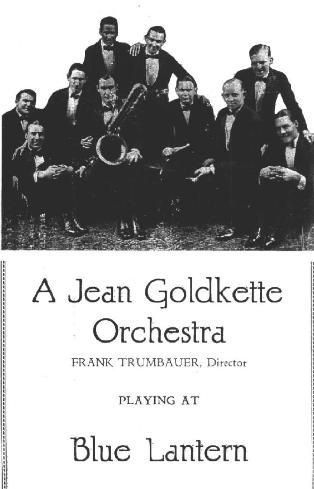
There were actually two parts to Bix’s stint with the Goldkette organization. First, in October of 1924,
he left The Wolverines in New York and hooked up with The Goldkette recording band at the
Graystone Ballroom in Detroit. Jean Goldkette was a classically trained pianist who, in later years,
played with the Detroit Symphony but who never played with his own bands. Goldkette touted his
Victor recording band as “sweet as Paul Whiteman and hotter than anybody.” To that end he hired
Bix as his “hot soloist.” This suited Bix fine since, at that time, he was not a great reader. But on their
first recording date a Victor recording executive found fault with Bix’s modern attack and insisted on
something tamer. So, in December, Goldkette sent Bix home with advice to get more training and
improve his reading.
By July of 1925, Bix was back with a Goldkette organization in which C-melody saxophonist Frankie
Trumbauer was also a member. “Tram” took Bix under his wing, taught him and assisted him. In
October of 1926, the full Goldkette Orchestra (with Bix) under the leadership of Trumbauer, opened
at the Roseland Ballroom in New York. The band lasted eleven months. Goldkette was remodeling
the Graystome Ballroom back in Detroit and could not meet that expense along with that of the band.
So, the band was dissolved; but not without making some wonderfully enduring recordings with Bix
under Goldkette’s name as well as with essentially the same orchestra under Trumbauer’s name:
MY PRETTY GIRL – was written in 1925 by Atlanta band leader Charles Fulcher as a stock dance
tune and was recorded by his band for Columbia in 1925. When Goldkette reedman Don Murray got
hold of it he arranged it into one of the hottest numbers in the Goldkette book – a real jazz classic.
Ironically, Danny Polo replaced the ailing Murray on the recording band’s only “hot” pressing for the
Victor label which heretofore had sounded stodgy with this otherwise hot band. Bix does not solo on
this 1927 recording but his presence is strongly felt. The star is bass man, Steve Brown.
CLEMENTINE (from New Orleans) - The recording of this Harry Warren tune in 1927 was the last
one Bix made with a Goldkette band (The Graystone Ballroom Orch.). Three days later the band was
dissolved. Bix takes his longest solo of any Goldkette recording on this one. Bill Rank, a trombonist
with the band said, “[This] was without a doubt the best recording we ever made,”
OSTRICH WALK - Credited to the members of the Original Dixieland Jazz Band: Ragas, Edwards,
LaRocca, Shields, and Sparbaro in 1918. This was recorded in 1927 for OKEH by a scaled down
Goldkette ensemble under the leadership of C-melody saxist Frankie Trumbauer. There is no bass,
tuba, or bass sax on this recording so Bix carries it magnificently from the topside.
I’M COMIN’ VIRGINIA - This 1926 tune was written by Donald Heywood and popularized by Ethel
Waters, whom Bix greatly admired. In 1927, along with the Trumbauer-led Goldkette group, two
other noted bands also recorded this tune: Paul Whiteman with Red Nichols on cornet, and Fletcher
Henderson
with Tommy Ladnier on trumpet. The “Time/Life” series on Bix says: this recording “…provides some
of the most passionate Bix on record.” The song was used in the 1965 Warren Beatty film,”Mickey
One.”
Big Band Bix (Part II): The Whiteman Era
After the Goldkette orchestra folded, bandleader Paul Whiteman extended an invitation to C-melody
saxophonist Frank Trambauer to join up with his band. But Frank chose to join conetist Bix
Beiderbecke and other players from the Goldkette stable in a band under the leadership of bass-
saxophonist Adrian Rollini at the Club New Yorker in Manhattan. From all accounts (mostly
musicians) the band was awesome, but it did not catch the public’s fancy and in less than a month
the band folded and the club closed. Paul Whiteman renewed his offer to Trambauer. Goldkette
arranger, Bill Challis, (a good friend of Bix’s and the man who preserved Bix’s piano compositions)
had already gone over to the Whiteman organization. He encouraged Whiteman to invite
Beiderbecke along with Trambauer. Whiteman listened to him and Bix became a member of the
Whiteman band. He and Tram joined Whiteman in October of 1927, in Indianapolis for a salary of
$200/week.
Life with the Whiteman band was very busy but Paul took good care of his musicians. They stayed at
the finest hotels and were served by solicitous staffs. Travel accommodations for the band were
provided in private railroad sleeper cars. As busy as the schedule was, Bix found plenty of time for
drinking. Amidst the strain of long strings of one-nighters, theater performances, concert dates,
recording sessions and, some say, disenchantment with not being able to play the kind of music he
wanted, Bix’s reliance on alcohol increased and his reliability decreased. Shortly after rejoining the
band in January of 1929, following a hospital bout with pneumonia, the Whiteman entourage arrived
in Cleveland for a series of theater engagements. It was here that Bix “snapped,” became violent and
had to be restrained. Pops Whiteman ordered him home to Davenport for the cure – still on full
salary. Bix came back but was never the same. It was the beginning of the end. After a short period of
traveling with the band he was again sent home to Davenport and his ties with Whiteman faded.
But during his time with Paul Whiteman and his orchestral settings, Bix recorded some of his most
memorable solo work. Here are some of the great tunes Bix recorded with Paul Whiteman:
DARDENELLA – was written by Felix Bernard who also wrote “Winter Wonderland” and Johnny S.
Black. It was introduced by the Ben Selvin Orchestra and later revived by the Prince Orchestra. Bix
recorded it with the Whiteman band for Victor in New York on Feb. 9, 1928. The Bill Challis
arrangement was kept in the Whiteman book for over ten years.
FROM MONDAY ON – was written in 1928 by Harry Barris who also wrote “Mississippi Mud” and
“Wrap Your Troubles in Dreams.” Bix recorded this with Whiteman for Victor in New York on Feb.
28, 1928. It included a vocal by The Rhythm Boys made up of the composer, Al Rinker, and Bing
Crosby. The arrangement was by Matty Malneck.
SUGAR – was written in 1926 by Maceo Pinkard who also wrote “Sweet Georgia Brown.” The lyrics
were by Alexander Bellinda (really Pinkard’s wife), Edna Belle Alexander. Maceo accompanied Ethel
Waters on the first recording of this tune on Feb. 20,1926 for Columbia. It was she who popularized it.
It was also sung in the 1955 movie “Pete Kelly’s Blues,” by Peggy Lee. Bix recorded it with Whiteman
for Victor on the same day as “From Monday On.” The arrangement was by Bill Challis.
CHINA BOY – written in 1929 by Dick Winfree and Phil Boutelje. It was revived in 1935 by Benny
Goodman and his trio. It was the Whiteman recording that popularized this tune in 1929. Bix plays a
gem of a 16 bar solo on this May 3, 1929 recording for Columbia in New York. The arrangement was
by Lenny Hayton.
| Earlville Association for Ragtime Lovers Yearning for Jazz Advancement and Socialization |