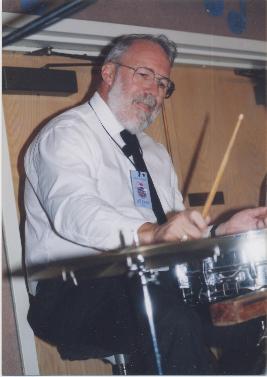
by Bert Thompson
Part 1
searches to replace cancelled flights, I was in New Orleans about to embark on a jazz cruise on which
the band I was in, Professor Plum’s Jazz, was to play. After the cruise I thought the effects of that
terrorist assault on the throngs of visitors that usually populate the city were slight. (The same was
not true of the number of passengers on the cruise, about half of whom were missing when the ship
sailed.)
In mid 2005 my wife and I decided it was time for a return visit to New Orleans, this time to take in
the French Quarter Festival, of which I had heard many good things. That year we were visiting the
Bude Festival in Cornwall, U.K., when Katrina hit, and we witnessed the devastation in New
Orleans on TV. We had already made our plans to attend the French Quarter Festival of 2006, but
decided to err on the side of caution and postponed them until this year, when the festival was
scheduled for Friday, April 13th through Sunday, April 15th. So we found ourselves back in The Big
Easy a couple of weeks ago, wondering just how much progress might have been made in the year
and a half or so that had passed since the Katrina tragedy and what might have changed.
The French Quarter, being on higher ground than much of New Orleans, escaped relatively unscathed
physically. Some roofs were damaged and still sport the blue tarps, but roofers, most from Mexico,
were busily working everywhere we went. The infamous potholes and other sidewalk hazards are as
plentiful as ever—no change from what was the case on all of my previous visits. Every morning the
storekeepers still hose down the sidewalks, and adding to their efforts is a new garbage collection
company whose trucks patrol the Quarter 24/7, literally, picking up the bags of garbage deposited on
the sidewalks and any other throwaway items, plus emptying the cans set out there as well as the city
receptacles, the result being streets that are cleaner than ever. Sidewalk areas where there are no
stores are pressure-washed by employees of the garbage company, all of them wearing black tee shirts
with the company logo emblazoned on the back, and others are sweeping the sidewalks and gutters
all day long. As if all of that were not enough, the company also has trucks that spray some kind of
disinfectant/cleanser on the streets, each followed by another truck that washes it all down the
gutters.
However, all is not well, as several discussions I had with merchants, together with what I could see,
attested. There were many real estate “For Sale” signs hanging from the balconies, advertising condos
or homes available for purchase, something I had never seen before, at least not in such numbers, on
any prior visit. Business is way off, I was told. One merchant said our purchase was the first of that
day, and it was late in the afternoon! Another antique dealer on Royal Street said he was just about
ready to call it quits as he was not making the rent for his store. On our visit to the relatively new
Riverwalk Shopping Mall, we saw that half of the stores were vacant. Indicative of all this was the
fact that before and after the festival the crowds, compared to those of past years, were thin. Outside
of the Quarter, especially in the 9th Ward, devastation is still painfully evident and not much
restoration is going on, although Habitat for Humanity is making valiant efforts, including the
“musicians’ village” they are helping erect. But many homes are just about as they were after the
water receded—windows gone, bare wall studs revealed by missing siding and, due to the wallboard’
s also being gone inside, providing a view into the ruined home itself. National Guard markings
indicating the building had been searched and noting the results, namely the number of bodies
found, are still to be seen spray-painted on the wall by the front door of almost every structure still
standing.
But the crowds of visitors returned for the festival itself. (Perhaps New Orleans could be revitalized
if it had a festival every single week of the year!) As the week progressed toward the opening of the
festival on Friday, more and more people came to town. There was a multitude of sites where music of
all sorts could be heard. Stages were erected on Bourbon (5) and Royal (4), Jackson Square (1), the
Old U.S.Mint (2), and along the levee from the Moonwalk toward the Aquarium of the Americas (3,
the area being known as Woldenberg Riverfront Park). In addition, several business establishments
offered jazz from noon until midnight before, during, and after the festival, including Fritzel’s
European Jazz Pub on Bourbon Street, Sean Kelley’s Irish Pub on St. Louis Street (just off Bourbon)
and the Palm Court Café on Decatur Street. (Preservation Hall did not participate in the festival
proper, but they were—and are, currently—open Thursday through Sunday nights for jazz and
Sunday afternoons for gospel.) Musical offerings varied from cajun, to zydeco, to blues, to funk, to
modern jazz, and, of course, to traditional jazz. Traditional jazz bands came from Germany, Sweden,
Canada, and the U.S., and these bands contained musicians from Australia, Scotland, England,
Switzerland, Denmark, and Norway, in addition to those from each band's country.
h
Part 2
I had the good fortune to be invited to play with some of the bands this year, the first gig being on
Wednesday at Sean Kelley’s Irish Pub with a group called Hans and His Ragtimers. Sean Kelley’s,
apparently a new venue with, of all things, a menu consisting of entirely Mexican food (!), has a
small stage which can not accommodate all the musicians, resulting in the rhythm section’s being
split with the piano and bass on one side of the stage and the drums on the other, resulting in some
occasional raggedness. Since at this time people were still arriving in New Orleans for the festival,
attendance was a bit sparse. From Sweden, Hasse Gille (Hans) is a 76-year-old who can still blow an
Armstrong-like cornet, reaching high C’s with just a little effort. The others in his group were Boa
Carlman, a banjo player also from Sweden, and Jack McLaughlin, a reed player from Australia. On
some of the later gigs they were supplemented by others from other bands. From Wednesday on,
however, the other gigs I played with them were well attended—one Thursday, one Sunday, and two
Monday.
The same was true of the other performances I took part in, right up to the official start of the festival
on Friday. On Thursday the KBR band, whose members are principally from Canada, played at Fritzel’
s and later at Sean Kelley’s. Fritzel’s, for those who have not been there, is a German-themed pub,
serving various brews, including schnapps. Its walls are lined with stickers, photos, etc., of bands
that have played there over the years, and clearly not much has been done in the way of redecorating
for many a year. The stage is tiny, but somehow all seven players in KBR managed to squeeze on to
it. The personnel consisted of leader Brian Towers on trombone, Joe Van Rossem on trumpet, Jack
McLaughlin on clarinet, Bill Evans on string bass, Ron Simpson on banjo, Marcello Bona on piano,
and Bert Thompson on drums. The band was first named after Kid Bastien of Toronto, the initials
standing for “Kid Bastien Remembered.” Today, however, it is said to stand for “King Bolden Rules”
—or anything else of one’s choosing. The music they play is New Orleans ensemble style and was
well received. They also played one set Friday, two sets Saturday, and two Sunday, including one
on the Continental Stage on Bourbon. This last venue left much to be desired because the stage was
erected almost right in front of one of the bars that was blasting “music” at ear-splitting decibel
levels. We could barely hear each other, but the crowed bravely stayed with us through the entire
set. Promises were made later that this situation would not be repeated in future. One can only hope.
The two other bands that I played with were the Magnolia Brass Band from Canada and Jack
McLaughlin’s OZ band. The Magnolia, consisting of several members of the KBR band and the
Happy Pals (Canada) band, supplemented by Kid Dutch from Florida on tuba, was one of the four or
five brass bands that played in the opening parade down Bourbon Street on Friday morning. The
Happy Pals is led by Patrick Tevlin (as is the Magnolia Brass Band), and with him on the trip were
several young players. The Happy Pals piano player, Roberta Hunt, performs the Grand Marshal
duties with the Magnolia. Marching down Bourbon Street playing Maryland My Maryland,
Salutation March, and countless other tunes is an experience I will not readily forget. I was sorry to
see it end when we came down St. Ann Street and stopped in the front of St. Louis Cathedral. Even
the weather cooperated beautifully as the sun shone brightly (Tuesday had rained all day, and there
was to be some more on Saturday). The Magnolia Brass Band made one more appearance on the stage
on Bourbon later that afternoon.
Jack McLaughlin’s OZ band—Jack leading on clarinet; Patrick Tevlin, trumpet; Brian Towers,
trombone; Marcello Bona, piano; Pete Clancy, string bass; Ole Jensen, banjo; Bert Thompson, drums—
made two appearances, the first being on the Continental Stage on Bourbon on Friday, the second in
Fritzel’s Pub early Sunday morning. Jack loves hymns and gospels, and his sets consist almost
exclusively these. In addition, he is a fervent disciple of the ensemble style of the old New Orleans
Bands, the result being there are no solos of any kind. I must admit I found it all quite congenial.
The Sunday morning set at Fritzel’s was the closest thing at this festival to the hymn/gospel set (often
given in a church) of other festivals, but somehow it did not seem so odd to be playing these
selections in a pub (after all the Salvation Army musicians did the same thing in days gone by),
although beer was not as tempting at that hour as coffee would have been! The proceedings were
recorded, so with luck there will be a CD some time down the road.
Other jazz bands which appeared but which I did not have a chance to hear other than a tune or two
from some, unfortunately, included the Canal Creepers (Sweden), Fat’s Jazz Cats (Germany), and the
Ponchatrain Owls (international). Other “local” bands which played only one or two sets were led
by Chris Burke, Jacques Gauthé, Lars Edegran, Duke Heitger, Jamie Wight, and Clive Wilson. It was
all, indeed, an embarrassment of riches.
I played my last gig on Monday afternoon with Hans and His Ragtimers, and they urged me to stay
on with them for the next two days, but I had to decline—seventeen sets in six days were enough for
me. There were two days left to my wife and me to pick up souvenirs for our kids and grandkids and
to see the 9th ward zone. There was also some more time to sample more of the marvelous New
Orleans cuisine—the po’ boys, the gumbo, the crawfish étouffée, the blackened catfish, the bread
pudding with whiskey sauce, and all the other super dishes the city is noted for. Then it was back to
Louis Armstrong airport for the flight back to California. But I can still hear a shopkeeper’s farewell—
“Now all y’all come back ‘n’ see us”—and the words of so many others to the effect that they
desperately need the tourists to return, to make healthy contributions to the local economy (as we
did). As our cab driver said on the way to the airport, “Tell ‘em we ain’t under watah!” O.K.,
consider it done!
|
|